

Blogs
4 Reasons to Love 3D Metal Printing
3D printers are an excellent choice for manufacturers. Here’s a look at why we love 3D metal printing. Now and then, a new technology disrupts the way things are done. 3D printers for manufacturers is one such technology. The invention of the 3D printer has made it possible for manufacturers across industries to create complex parts quickly and effortlessly. Various types of plastic and metal raw materials can be used in 3D printing to make prototypes, product models, and even final products. Here’s a look at our four reasons to love 3D metal printing. 1. 3D metal printing is eco-friendly Traditional manufacturing methods make use of a subtractive manufacturing process. The process starts with a block or bar of material. Parts are created by boring, cutting, grinding, or drilling to remove extra material from the original block. Unfortunately, manufacturers cannot reuse the wasted material. For example, airplane manufacturers who use traditional manufacturing processes can discard as much as 90% of material that cannot be used in the future. 3D printers make use of an additive manufacturing process. The process adds instead of subtracting raw material. Metal parts are built by depositing the material (supplied as a fine powder), layer by layer, as per digital 3D design data. The additive manufacturing process makes use of only as much material that is required to create a part. As a result, there is minimal wastage (on average, 5% of material wastage compared to 90% material wastage by traditional manufacturing processes). That makes 3D printers an excellent choice for manufacturers. 2. 3D printers can create complex parts Need to create unique or complex structures that are strong but also lightweight? Traditional manufacturing processes cannot do that easily. There are several design restrictions. So, multiple separate metal parts will need to be created and then put together. As well as that, the more complicated a part, the more expensive it is to make. Plus, the entire process is cumbersome and time-consuming. Another problem is the wastage of material. With a 3D printer, manufacturers can now create highly complex metal parts easily and quickly. There are no design restrictions. Instead of creating multiple parts and then putting them together to create one complex structure, manufacturers can use 3D printers to make a single, complex metal piece. Another advantage – there is no wastage of material. 3. 3D printers make use of a single-step process Traditional manufacturing is complicated and includes multiple processes and multiple machines for injection molding, machining, forming, and joining. 3D printing is a single-step manufacturing process. That saves manufacturers time and costs associated with having to use multiple machines. You can set up a 3D printer and get the work done without operators on the floor during the entire production time. 3D printing is a hand-off process that uses a computer numerical control (CNC) machine – a machine that is operated or controlled by a computer. The manufacturer gives the CNC machine a CAD file, and the machine undergoes a series of operations to create the design. That means, by simply pressing a button, you can create a metal part that you design. Do you need to make changes to your design? Simply complete the necessary changes on your computer and then reprint the design. 4. A 3D printer for manufacturers offers a cost-effective solution Let’s be honest. Costs are an essential consideration when manufacturing components. Creating even a simple prototype using a conventional method of manufacturing can be expensive. Then there is the cost of producing large volumes of a part. While traditional fabrication methods like injection molding and casting get cheaper with manufacturing increased volumes, manufacturing low or medium volumes by these methods can be very expensive to implement. 3D metal printing makes use of automated processes that incur almost no overhead costs, making it a cheaper option. It does not cost much more to create one part or 100 parts. So, some traditional manufacturing processes might be more affordable to manufacture high volumes of metal parts. But 3D metal printing is the ideal cost-effective solution to create low and medium volumes of metal parts and rapid prototyping. 3D printers for manufacturers make use of an additive process, and there is no material wasted. So, you can save material and, therefore, reduce costs. Finally, it is possible to create complex and intricate shapes at no additional cost. There is no doubt that a 3D printer is a boon for manufacturers. Not only is metal 3D printing a massive cost-saving solution, but it also saves an immense amount of time. It has fantastic material-saving benefits and does away with all the complexity associated with traditional manufacturing processes – and these are our reasons to love 3D metal printing. DesignPoint is made up of a qualified team of experienced engineering professionals who specialize in providing complete 3D software and hardware solutions for engineers.
3D Printing with Metal Alloy Powder May Make Ultra-strong Metal Parts
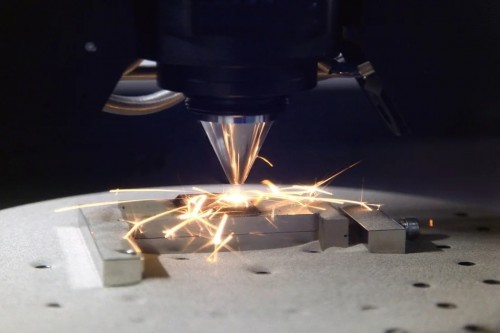
Most common metals, including iron, steel, tin, nickel, copper, aluminum, and titanium, as well as refractory metals such as tungsten, molybdenum, and tantalum, are available in powder form. Alloys such as bronze, brass, stainless steel, and nickel cobalt superalloys are also available in powder form. Metal powder formulations include some grades of stainless steel, low alloy steels, and nickel and cobalt alloys, some of which have applications in the aerospace and automotive industries. Many metal powders can be tailored to specific 3D printing, or additive manufacturing, technologies. Potential advantages of 3D printing with metal include simplified, faster manufacturing of improved products, and the flexibility to create these parts closer to the point of need. It is these potential advantages that Army researchers hope to exploit to create steel alloy parts from powder. An article on the U.S. Army Research Laboratory website explains that Soldiers needing replacement parts may turn to 3-D printers in the future to rapidly deliver reliable and ultra-strong metal parts. The researchers are using an alloy originally developed by the U.S. Air Force that has been adapted to powder form. Using a method called Powder Bed Fusion, the 3-D printer’s laser selectively melts the powder in a pattern. The printer then coats the build plate with another layer of powder and the process is repeated until the part is complete. “I think it’s going to really revolutionize logistics,” said Dr. Brandon McWilliams, a team lead in the lab’s manufacturing science and technology branch. “Additive manufacturing is going to have a huge impact on sustainment.” “We’re able to print up parts with internal structures that they would not necessarily be able to create with that much dimensional accuracy where they try to use mill or machine part,” said Dr. Andelle Kudzal, a materials engineer on McWilliam’s team. The laboratory is working closely with industry and academic researchers to model new alloy designs, perform computational thermodynamics and expedite the process to get the materials to Soldiers. (Read the full article.) 3D printing with metal still has limitations. According to an article on phys.org, parts produced using selective laser melting (SLM) and other powder-based metal techniques often end up with gaps or defects caused by a variety of factors. Another article on ScienceDaily.com describes efforts led by researchers from Carnegie Mellon University and Argonne National Laboratory to identify how and when tiny gas pockets form in 3D printed objects, as well as a methodology to predict their formation, a discovery that could dramatically improve the 3D printing process. Like traditional metal manufacturing, the success of 3D printing with metal powders depends on knowing that the chemical composition of the metal being used is right for the application. Metal powders can undergo chemical composition analysis to determine the amount of metallic or non-metallic impurities (elemental form, or in dissolved form as solid solution or as compounds). Wavelength-dispersive x-ray fluorescence (WDXRF) and energy-dispersive x-ray fluorescence (EDXRF) are elemental analysis technologies that easily and positively characterize any metal powder. Laboratory-based XRF systems can evaluate all kinds of materials and sample types for qualitative and quantitative analysis for process and quality control in a variety of metallurgical applications.
What Can You Do with Metal 3D Printing?
Metal 3D printing is changing the way we create parts. In low- to mid-volume production runs, the parts themselves can be made faster, cheaper, and with lower effort than traditional manufacturing processes. Since additive manufacturing forms parts in such a different way, it makes it much easier to produce certain types of parts that require complex features. The process uses no tooling, is almost fully automated, and adds rather than removes material to allow for more optimized geometries. This makes metal 3D printing a great fit for parts that might be traditionally very difficult or expensive to manufacture, including legacy parts, line automation tools, and functional cast prototypes. Metal 3D printing made these gripper jaws more effective on the production line. This set of gripper jaws, for example, moves pieces of sheet metal to and from a press brake. These jaws were 3D printed in metal, and solve three problems for the shop that uses them: 1. The gripper jaws are printed using 17-4 PH Stainless Steel, which has high-abrasion resistance. This means the jaws won’t wear down from repeated contact with the steel sheet metal parts. 2. The closed-cell infill within the part makes it much lighter than a traditional steel part, meaning the arm can move faster than with a machined equivalent and output higher yield. 3. The tips of the jaws are shaped and low-profile to avoid the press brake tooling, but designed to grip the part securely. This would have been difficult and expensive to machine out of the same material, so they decided to print the complex geometry instead. The Metal X can solve a lot of problems when it comes to manufacturing, and you can see more of these solutions on our Applications page. Many of these examples stem from three core benefits of additive manufacturing, and how they can help cut down your cost per part: Three Benefits of Metal Additive Manufacturing Geometric Freedom: Complexity and optimization come at a cost for most traditional manufacturing processes — additional features mean more operations, longer machining time, or multi-part molds. These all heavily consume both material and your machinists’ time. Additive manufacturing removes many of these constraints. The process builds material up instead of cutting it down, so its design methodology encourages putting material exactly where it is necessary, at no cost to the operator. In fact, you consume less material and time by doing so. Full Automation: Metal 3D printers require minimal designated operator time. The printer’s software automatically generates toolpaths based on configurable settings, so no specialized manufacturing knowledge is needed to work with a given material — the machine handles all of that based on your selections. Once you kick off a print, it can operate without supervision, so you can maximize machine uptime by letting the printer run during non-working hours. Minimal Tooling or Setup: When making a part with traditional methods like milling, turning, or molding, some amount of effort and time needs to be spend non-revenue generating parts. These are parts that support the manufacturing of the final part, including custom tooling, workholding, or molds. Metal 3D printers can create parts without extra manufacturing work or machine setup — all you have to do is press print to get the machine started!